12/12/2025
Understanding Satiety: Feeling fuller for longer
Understanding Satiety: Feeling fuller for longer
Have you ever wondered why some meals keep you full for hours, while others leave you instantly ready for the next? With nutrition, there is a lot at play, and one very important factor is satiety.
Satiety is the signal sent to our brains when we're beginning to feel full.¹ It's a powerful signal, that is heavily influenced internally, environmentally, and behaviourally.¹ It can help to explain why two meals with equal energy could leave you feeling full on one hand, or wanting more on the other.
When we understand satiety, we can work towards improving eating habits, managing cravings, supporting weight, and most importantly achieving our health goals.²
Here we will discuss satiety, the science behind it, and how it is implemented within FoodSee to help you make satisfying food decisions effortlessly, while leaving restriction behind.
What Is Satiety?
Satiety can be defined by a decrease in hunger when eating, alongside an increase in fullness after eating. It's an important factor when it comes to the amount that we eat, or when put simply, our bodies way of telling us it has had enough food for now.³
When thinking of satiety, the feeling of fullness in our stomach comes to mind, this is known as stomach distension.² Whilst this feeling is important, internally there is a lot more going on:
Starting in the mouth: Think about how the chewing involved in eating a croissant compares to the chewing involved in eating a handful of nuts? Food structure influences the act of chewing and therefore can have an impact on satiety.²
Hormones: The action of food passing through our gut releases hormones to prepare the rest of the body for the food coming in, hormones such as GLP-1.⁴ Did you know that GLP-1 medications (for example Ozempic, Wegovy, Mounjaro) work to mimic this hormone, resulting in increased satiety?⁴
Digestive speed: Whether it's fast or slow, food leaves our stomach and the rate this takes place can impact how much we eat at both this meal, and the next.¹
Food composition: Protein, fibre, fat, and water, especially in combination, play a role in digestion speed, and therefore impact our satiety.¹
These are only a few of the internal factors taking place to influence satiety, not to mention our external environments and behaviours.² Together, these factors not only influence how quickly hunger returns after a meal, but also the foods we eat at the next.
Satiety vs. Satisfaction
Two terms that have different meanings but can often be confused. We’ve learned that satiety is the physiological response to eating, when we start feeling less hungry, more full, and stop eating.³ Satisfaction is different, it relates to the pleasure of eating, think taste, flavour, and texture.² Sometimes, you might eat a meal that is considered high satiety, it fills you up but you don't feel satisfaction, maybe you're still craving something crunchy, or something sweet? Ideally, a meal that leaves you feeling satiated is one that you enjoy (satisfaction) and full (satiety).
Foods to Help You Feel Full and Satisfied
Alongside internal and external factors, research has found that the composition of foods play a major role in satiety.¹ The macronutrients (proteins, carbohydrates, and fats) in our food are important to consider, but as we know, it's not often we eat a single food in isolation! So when creating your meals, aim for a balanced plate to increase satiety.⁵ To better understand these macronutrients and how they influence satiety, take a look at our 'The Nutrients That Drive Satiety' Blog.
Prioritising Satiety for Simple, Sustainable Eating
Prioritising satiety from meals means we can work toward meeting our nutritional needs, health goals, and body composition goals while enjoying food and avoiding restriction. Balanced meals that include fibre, protein, carbohydrates, and healthy fats can help us to feel satisfied.⁶ When our meals offer satiety and satisfaction, we feel energised, without restriction and rules.
How FoodSee Makes Satiety Simple
Snap a photo of your meal, and FoodSee does the work to inform you of:
The foods in your meal
The nutrient composition of those foods
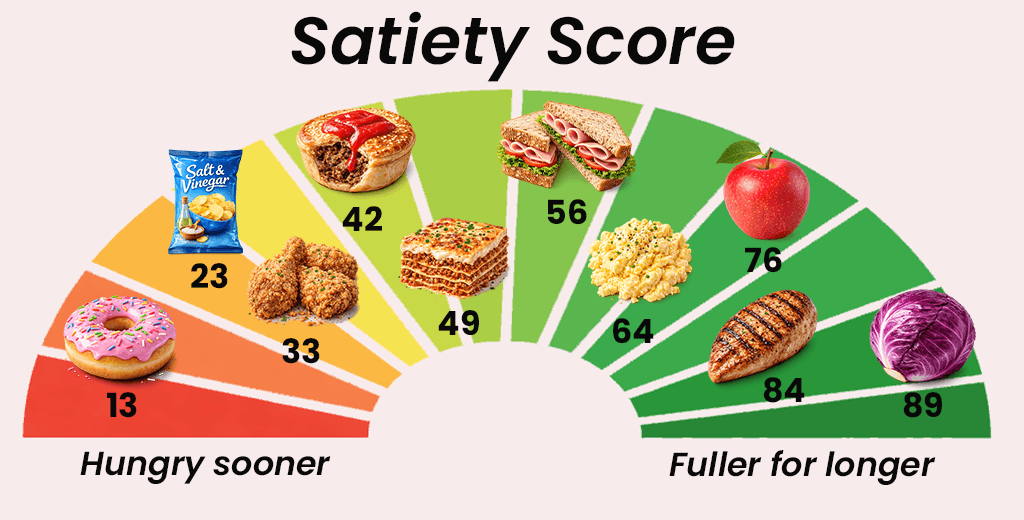
The likely satiety score of your meal
Using AI and nutritional analysis from Australian nutrient databases,⁷ you get instant insight into how filling your meal is, alongside simple suggestions on ways to increase satiety in the future if you need it. This can be used as a tool to help you to understand how meals can impact your satiety throughout the day. By choosing meals or making simple swaps that keep you fuller for longer, you can take small steps to support your nutrition in a sustainable way. FoodSee allows you to see satiety and make food choices that support your goals.
Sources
Garutti M, Sirico M, Noto C, Foffano L, Hopkins M, Puglisi F. Hallmarks of Appetite: A Comprehensive Review of Hunger, Appetite, Satiation, and Satiety. Current Obesity Reports. 2025;14(1):12. http://doi.org/10.1007/s13679-024-00604-w
Rakha a, Mehak F, Shabbir MA, Arslan M, Ranjha MMAN, Ahmed W, et al. Insights into the constellating frivers of satiety impacting dietary patterns and lifestyle. Frontiers in Nutrition. 2022;9. http://doi.org/10.3389/fnut.2022.1002619
Chambers L, McCrickerd K, Yeomans MR. Optimising foods for satiety. Trends in Food Science & Technology. 2015;41(2):149-60. https://doi.org/10.1016/j.tifs.2014.10.007
Drucker DJ. Mechanisms of Action and Therapeutic Application of Glucagon-like Peptide-1. Cell Metabolism. 2018;27(4):740-56. https://doi.org/10.1016/j.cmet.2018.03.001
National Health and Medical Research Council. Eat for Health Educator Guide. Canberra; 2013. http://www.eatforhealth.gov.au/sites/default/files/files/the_guidelines/n55b_eat_for_health_educators_guide.pdf
Holt SHA, Petocz P, Farmakalidis E. A Satiety Index of Common Foods. European journal of clinical nutrition. 1995:49:675-90 http://www.researchgate.net/publication/15701207_A_Satiety_Index_of_common_foods
Food Standards Australia New Zealand. AUSNUT 2023: Food Standards Australia New Zealand; 2025. http://www.foodstandards.gov.au/science-data/food-nutrient-databases/ausnut/food-nutrients